THE MEMPHIS TRIPLE DISASTER ~ Executive Summary | The Series Landing Page
The whole story in 1,600 words. Three-phase disaster narrative: flood → earthquake → tornadoes. Closes with Ortega: "Memphis was our first test. We passed. Barely. The next test is coming. We intend to do better."
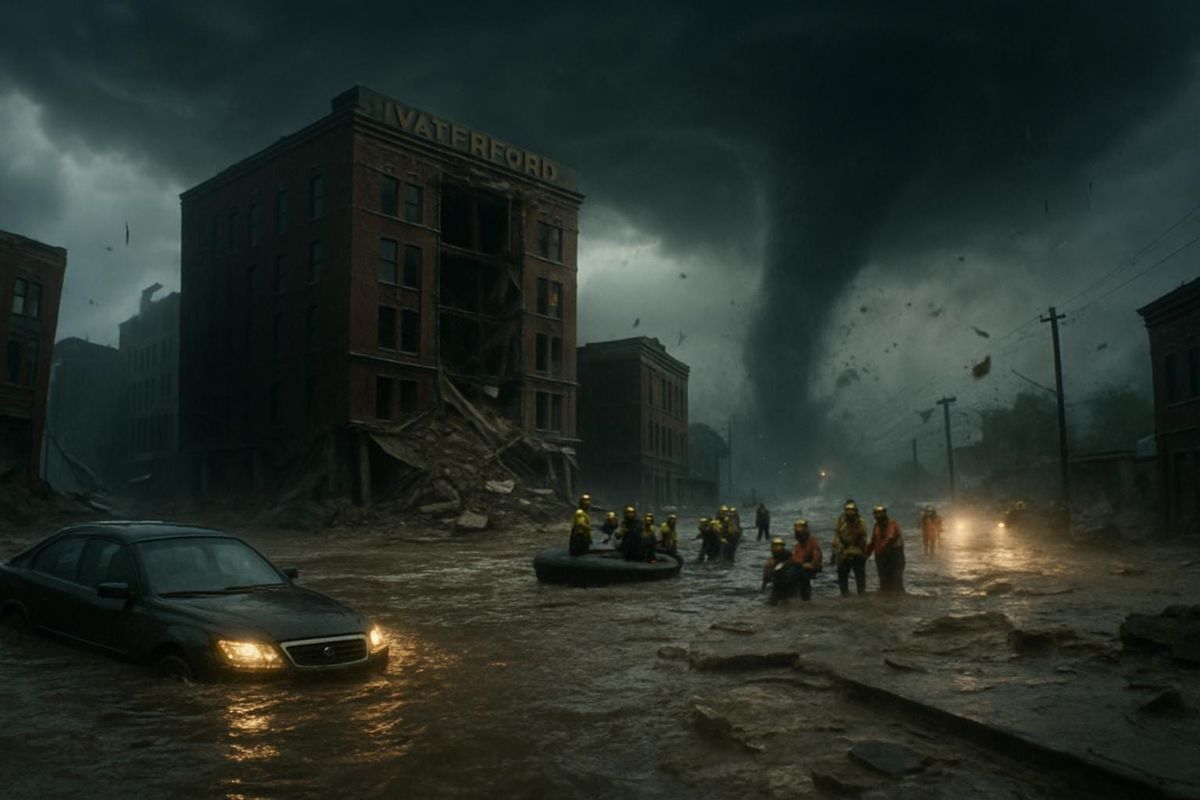
Three cascading failures. 52,000 displaced. 247 lives saved. 391 lost.
Memphis, September–October 2025 — the case study that defined THE NET.
If you read nothing else, read this. This is the full story in 1,600 words — what happened, what we tried, what worked, what didn't, and what it cost.
Ready to go deeper? Start with Chapter 1: Framework Overview →
THE MEMPHIS TRIPLE DISASTER
Executive Summary
THE NET: The Network Empowering Tomorrow
Report Date: October 24, 2025 | Version 1.0
"Two hundred forty-seven lives saved through coordination. That number isn't abstract to me. Those are people who went home to their families. We also lost people. 391 deaths we couldn't prevent. This report honors both truths."
— Commander Felicia Ortega, Central Regional Command
What Happened
On October 3, 2025, a magnitude 6.5 earthquake struck the New Madrid Seismic Zone—the largest in the region since 1895. But the earthquake was only one element of a cascading disaster that had already been building for days, and would continue to compound in the hours that followed.
The disaster unfolded in three phases. First came the flood: a stationary weather front dumped 13.2 inches of rain over five days, pushing the Mississippi River to 45.7 feet—nearly twelve feet above flood stage. Memphis was already underwater when the earth began to shake. The earthquake struck at 10:00 AM on October 3, lasting forty-two seconds, collapsing buildings already stressed by saturated soil and standing floodwater. Liquefaction turned riverfront areas into quicksand. The historic Waterford Hotel, built in 1927, survived fourteen seconds before its south wall gave way. Twelve people died in that collapse alone.
Eighteen hours later, as rescue teams worked through the night pulling survivors from earthquake rubble, three supercells spawned tornadoes that ripped through the damaged city. The strongest—an EF-3 with 165 mph winds—carved a half-mile-wide path directly through downtown Memphis, striking buildings already weakened by seismic forces. The compound failures were catastrophic: structures that had survived the earthquake collapsed under tornado winds they might otherwise have weathered.
The final count: 391 confirmed dead. 1,847 injured. 52,000 displaced from their homes.
The Warning Signs
THE NET—The Network Empowering Tomorrow—is a disaster response coordination framework built on a simple premise: multiple independent intelligence sources, when they converge, provide warning that single-domain monitoring cannot. In the week before Memphis, four such sources began screaming.
On September 26, weather models showed a stationary front developing. That same day, a snake named Cleopatra began pacing her enclosure in Memphis with unusual agitation—behavior her handler Lola Rodriguez had only seen twice before, once before a major storm and once before an electrical fire. Dr. Clay Kershaw's prairie dog observation network reported forty-seven animals on surface patrol across Great Plains colonies; normal count was eight to twelve. In Oregon, tortoises displayed circling behavior associated with seismic sensitivity.
By September 29, THE NET's crisis hotline was running 23% above baseline—not calls about weather or flooding, but calls reflecting generalized anxiety, sleep disturbances, inexplicable unease. Thor Lowe, the quantum consciousness specialist whose "sock network" had called the Fremont tornado outbreak four days in advance, reported sustained field compression across his monitoring system. On October 2, his readings went completely silent. "The socks are holding their breath," he told Commander Ortega. "When they exhale, it's going to be loud."
Four independent systems. All converging. All pointing at Memphis.
The Decision to Act
On September 30, Commander Felicia Ortega made a decision that traditional emergency management would have considered premature at best, reckless at worst. With no confirmed disaster, no federal authorization, and no certainty of what was coming, she authorized the pre-positioning of three supply convoys—thirteen tractor-trailers carrying medical supplies, food, water, shelter materials, and communication equipment—at staging points 100 miles from Memphis.
The commitment: $147,000 in resources and personnel. The basis: animal behavior, quantum consciousness readings, crisis hotline patterns, and converging weather models. The traditional response: wait for confirmation, then react.
"The cost of being wrong is money," Ortega later explained. "The cost of being slow is lives."
When Thor's socks screamed at 8:30 AM on October 3, Ortega made another unconventional call: she ordered all rescue teams to withdraw from Memphis. Ninety minutes to get everyone on dry land, away from buildings, away from water. At 9:42 AM, the last rescue boat reached shore. At 10:00 AM, the ground betrayed them.
Forty-seven first responders who would have been in the water, in damaged buildings, in the direct path of collapsing structures, were on safe ground when the earthquake hit. Zero first responder fatalities.
The Response
Because convoys were pre-positioned, not waiting for authorization in distant warehouses, the first supplies arrived in Memphis six hours and fifteen minutes after the earthquake—sixty-six hours ahead of traditional reactive deployment timelines. Forward Command was operational in Jackson, Tennessee within ninety minutes. ATLAS mobile mental health units were serving trauma survivors by 9:00 PM.
The ONE RING crisis hotline—built on a three-layer overflow system that routes calls from sectional hubs to cross-regional support to volunteer networks—handled 332% of baseline call volume without putting a single caller on hold. When people called in the worst moments of their lives, someone answered.
Civilian partnerships multiplied capacity in ways no government agency could match. Steve Erkal, owner of a building supply company who had overbuilt his warehouse to F5 tornado standards, sheltered five hundred people when the tornado sirens sounded. His building didn't even creak while the EF-3 passed overhead. GhostWire Radio, an informal CB network run by trucker Tony Williams, broadcast emergency information to populations without power, without cell service, without access to official channels. Religious charities coordinated through THE NET delivered 22,000 meals per day during recovery operations.
The Human Stories
The statistics tell one story. The people tell another.
Dr. Janet Chen, a surgeon at Regional Medical Center, began a sixty-hour marathon when the earthquake interrupted her routine appendectomy. Over the next three days, she operated on thirty patients, saved lives in conditions no medical school could simulate—suturing by work light, managing sedation with dwindling drug supplies, performing an emergency C-section during the tornado to deliver a baby girl who would be named Hope. When Atlanta reinforcements finally arrived on Day 3, Chen had to be ordered to stop operating.
Team 7, a rescue squad working the Orange Mound neighborhood, was extracting earthquake survivors when the tornado struck. The building collapsed around them, trapping six first responders and two civilians in a basement void space with water rising from the saturated ground. No federal urban search and rescue team could arrive for four hours. They had two hours before drowning. Sixty-two volunteers—construction workers, farmers, an off-duty mine rescue specialist, a former firefighter named Darnell Washington who'd left the department but knew confined space extraction—dug them out by hand. A submersible pump running through a gap found by touch slowed the water rise just enough. One responder went into cardiac arrest during extraction; field needle decompression saved his life. Eight souls, zero fatalities.
Lola Rodriguez, the snake handler whose python Cleopatra had been the first animal indicator, evacuated Memphis three days before the earthquake based solely on her snake's behavior. She later learned that her apartment building—the one she would have been sleeping in—was destroyed by the tornado.
Mike Thornton, a tattoo artist who'd refused boat evacuation during the flood, survived the earthquake in his cast-iron bathtub after receiving a two-word text from a friend: "Bathtub. NOW." The gas station beneath his apartment collapsed; his building tilted; floodwater poured through broken windows. But the tub held. When he emerged, his first act was to crack open one of the two Mountain Dews that had survived with him. His apartment building, already compromised, was destroyed by the tornado eighteen hours later. Mike was in Steve Erkal's warehouse by then, drinking Mountain Dew, listening to the freight train sound pass overhead.
The Results
An estimated 247 lives were saved through early warning and coordinated response. The predictive pre-positioning, the ninety-minute earthquake withdrawal, the crisis hotline infrastructure, the civilian partnerships—each contributed to outcomes that would have been worse under traditional reactive models.
Response cost: $4.4 million. Value generated through lives saved, infrastructure protected, and accelerated recovery: $339 million. Return on investment: 77 to 1.
Power restoration in Memphis went from 8% to 89% in seven days, coordinated through PHIN0-Energy systems and executed by electrical crews from Atlanta—including vocational students who gained more real-world experience in one week than most apprentices see in a year.
But the numbers only capture part of the truth. 391 people died. Some of those deaths might have been prevented with better training, faster coordination, more resources. The after-action analysis identified critical gaps: food demand was underestimated by 34%. FEMA integration lost eight hours to terminology and process friction. No formal training existed for interpreting animal intelligence or responding to compound disasters.
The Path Forward
Memphis was THE NET's first major test. The framework passed. Barely.
USGS assessment indicates 63% probability of a magnitude 5.0 or greater aftershock within ninety days, 12% probability of a magnitude 6.0 or greater event within 180 days. New Madrid isn't finished with the region. The training gaps and system improvements identified in the after-action report must be implemented within six months, not eighteen months.
Beyond New Madrid: hurricanes, tornadoes, floods, fires, pandemics, and disasters we haven't imagined will continue to test human resilience. THE NET exists to ensure that coordination capability matches disaster scale—that the gap between local capacity and federal response isn't where people die.
The 247 lives saved represent proof of concept. The 391 lives lost represent the ongoing obligation: to close gaps, build training, strengthen relationships, and improve systems so that the next response is better than this one.
"Memphis was our first test. We passed. Barely. The next test is coming. We intend to do better."
— Commander Felicia Ortega
─────────────────────────────────
THE NET: The Network Empowering Tomorrow
Memphis Triple Disaster Documentation Suite — Executive Summary
Series navigation:
Chapter 1: Framework Overview →
Read the full series:
- Executive Summary ← you are here
- Framework Overview
- ONE RING Crisis Hotline
- Supply Chain Coordination
- Crowd Psychology & Messaging
- Animal Intelligence Networks
- ATLAS Mobile Services
- AI Coordination Systems
- Human Coordination & Command
- Training & Readiness
- After-Action Report
- Dramatis Personae — Character Reference
Bonus: The Minute-by-Minute Companion
Resource: When You Can't Speak — Silent Safety Tools for Domestic Violence Situations — free public safety resource, no paywall
A NET Universe Production
Written by Travis Jenkins — User Zero
Part of the Memphis Triple Disaster series
MPC Universe | 875+ Characters | 18 Regions | 333 Cards
Music: @Underground_Frequency on Suno
the-network-empowering-tomorrow-the-net.ghost.io