I Did It, You Can Too — The Scholarship Revolution
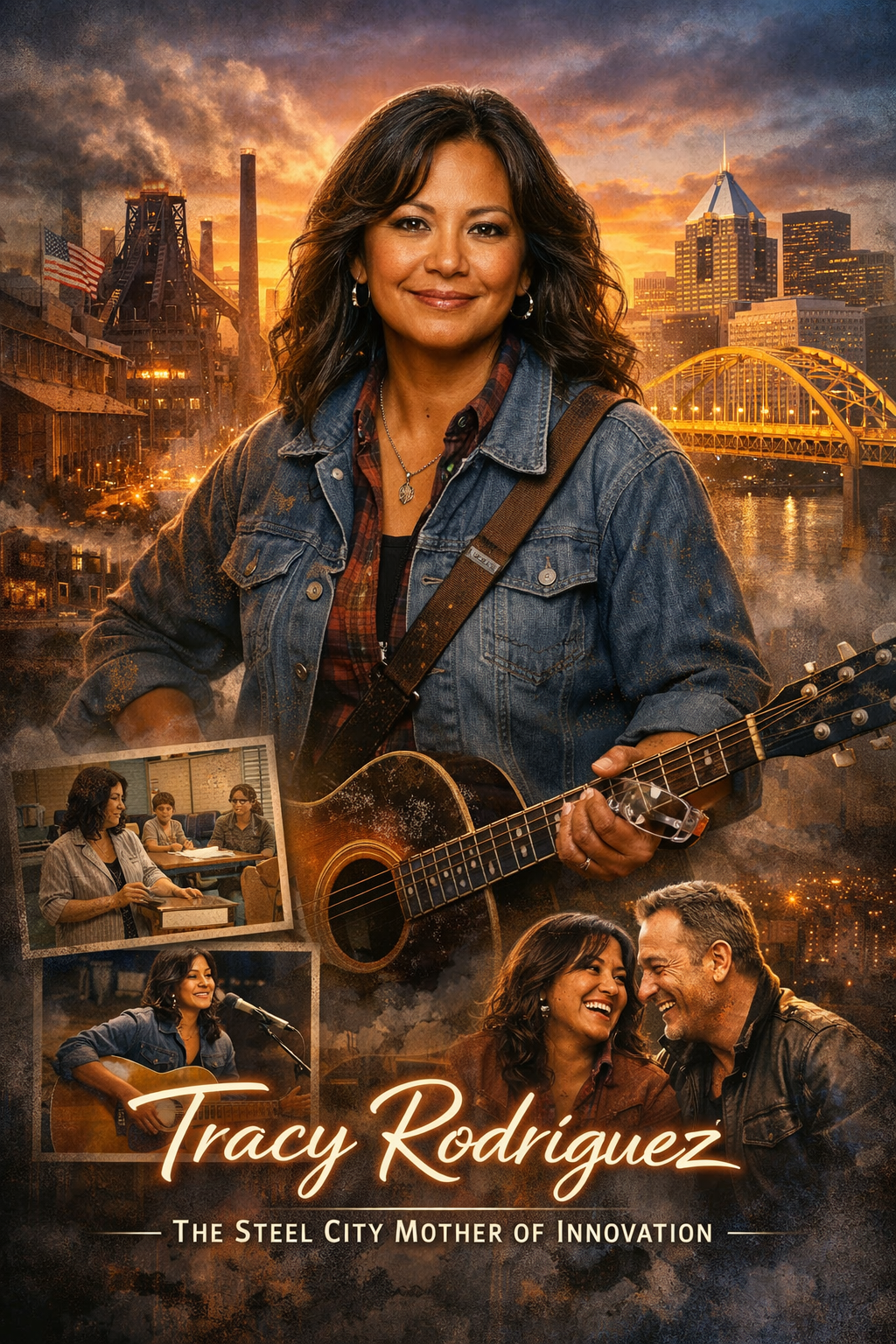
The full-length Tracy Rodriguez epic: steel-mill collapse, night-school computer-science degree, the living-room tutoring revolution that scaled into state policy. The MPC Universe's cornerstone education story.
The sodium-vapor lights over Jimbo’s flickered like tired fireflies, humming in the warm pine-sap air. Diesel ghosts and fryer oil clung to the parking lot; crickets sawed at the darkness. Rusty’s Cybertruck—half starship, half farm implement—idled in a low electric purr, its tow rig silhouetted against a sky smeared with highway glow and distant lightning. On the cracked asphalt, NULL the Quantum Penguin did lazy circles on its glowing one-wheeled ride, blue light spilling over cigarette butts and gravel like a portal testing the edges of reality.
“Y’all need a quantum RoboUberLyft Taxi & Tow outta here?”
Rusty leaned an elbow out the driver’s window, straw hat tilted back, PhD hoodies and grease stains coexisting on the same flannel. “My rates are reasonable and time”—he tapped the holographic dashboard—“is negotiable.”
Beside him, the Stanford Tree flickered into higher resolution, its holographic branches stretching just enough to brush the cracked windshield. The googly eyes spun, recalibrating probability fields invisible to everyone except NULL and a couple of very confused satellites.
A message bloomed in midair, projected from the Tree’s trunk like phosphorescent bark:
P I T T S B U R G H
S T E E L C I T Y C O M M A N D
— PRIORITY PING —
“MILLS CLOSED NOW, KNOWLEDGE FLOWS.”
NULL whistled—a sound like a modem trying to imitate birdsong—and pushed its sunglasses up the bridge of its beak.
“Steel City Command again,” it said, voice somehow both squeaky and echoing, like a rubber duck in a cathedral. “Third request this week. Someone up there keeps collapsing our waveform.”
Rusty squinted at the map, which wasn’t so much a map as a lattice of glowing ley lines: interstates overlaid with old cattle routes, fiber optic cables braided into underground limestone caverns, ghost rails from defunct steel lines. Every node pulsed with metadata, and some of that metadata had opinions.
“Florida–Georgia pinewoods to Pittsburgh in one hop,” Rusty murmured. “That’s a long haul even for time-flex.” He flicked another holo-tab open. “What’s the payload?”
The Stanford Tree rustled its ghostly leaves, then pushed a text thread into the air:
UNKNOWN NUMBER:
We turned off the furnaces. We turned on the classrooms.
Tracy Rodriguez said: I did it, you can too.
We believed her. Now something’s…off.
Kids learning faster than time. Planes drawing shapes in the sky that mess with people’s dreams.
Limestone’s talking. Need a calibration tow. You in?
A low whistle slipped from Rusty’s teeth. The name Tracy hung in the cabin like incense—faint, powerful, and impossible to pin to one source.
Nobody in Rusty’s world ever knew Tracy directly.
It was always:
“My cousin’s pastor mentioned her.”
“Lady at the scratch-off counter swears her nephew took that class.”
“Mechanic said some woman did night school and now runs the whole block.”
The Rodriguez Educational Network was less a school and more a rumor that had learned how to file paperwork.
NULL hopped off the unicycle, the wheel balancing itself next to the truck like a patient moon.
“Observation note,” it chirped. “This smells like a phase shift. Mills close, schools open, then the schools start bending the timeline. You know what she teaches, Rusty.”
Rusty did. Or at least he knew the slogan that had bled through truck stop bathrooms, YouTube sidebars, and community center flyers:
SURRENDER
SOFTEN
SHIFT
BLOOM
Sometimes it was printed over mountains at dawn, sometimes over city skylines, sometimes on the back of receipt paper in ballpoint ink. A lot of people thought it was just mindfulness. People who thought that had never watched a county’s dropout rate fall faster than statistics could explain.
“Tracy’s method,” Rusty mused, drumming calloused fingers on the steering wheel, “turns closed doors into wormholes. You soften around a stuck place, you shift one belief, and suddenly whole towns are different. Guess Pittsburgh hit critical mass.”
The Tree dimmed the cabin lights, throwing up a new hologram: a retro poster in sepia-gold and deep teal.
A penguin in sunglasses—NULL, or a future NULL, or a NULL from a timeline where it had a pension—stood on a steel beam over a skyline of smokestacks and radio towers.
PITTSBURGH
STEEL CITY COMMAND
Mills Closed Now – Knowledge Flows
“Nice merch,” NULL said, admiring its hypothetical likeness. “Didn’t sign a licensing deal, though.”
Rusty watched as more stats flowed around the poster:
- Educational transformation: 89% district satisfaction
- Aviation research teams: 12 contracts, geometric flight patterns over the rivers
- Underground operations: limestone consciousness network, continental coordination
- Tourism & cultural preservation: 340,000+ yearly visitors tracking a story they can’t quite tell
Beneath that floated three shimmering river lines converging into one node: Allegheny, Monongahela, Ohio. The junction pulsed, each beat syncing with Rusty’s chest.
“Three rivers,” he muttered. “Three major sports teams. Three primary program tracks. Somebody’s been playing with triadic resonance.”
NULL’s eyes glowed softly. “Or with kids.”
The Tree, in a rare serious moment, centered another file: a scanned drawing, edges crumpled, colored pencil strokes furious and earnest.
A Cybertruck tow rig, boxy and impossible, shot down a highway made of notebook paper. On the hood: ETHAN’S in uneven letters. On the roof: a little penguin, drawn too big for scale, radiating motion lines and something that might have been quantum blur or just messy coloring.
In the bottom corner, in a nine-year-old’s handwriting:
Null & Rusty – Time Tow Rangers
Below that, in pen, older cursive had added:
Season 3 idea: Pittsburgh episode. Steel City School Ship. Airplanes make math in the sky.
Rusty frowned. “This ain’t from our side of the windshield.”
The Tree answered with a soft chime:
ORIGIN: UNKNOWN
FIRST APPEARANCE: COMMUNITY CENTER RECYCLING BIN, NORTHSIDE PITTSBURGH
STATUS: CONCEPT BLEED-THROUGH
Somewhere—maybe in this timeline, maybe one click of the dial away—a kid had started doodling Rusty’s tow truck at nine. Refined it at fifteen. Turned it into an animated web series pitch at twenty. The stories had spread before the episodes ever existed, ink passing from classroom to classroom, neighborhood to neighborhood, same way Tracy’s method did.
The fiction had gotten loose.
And now, according to the Pittsburgh ping, the fiction was starting to edit the city back.
NULL stretched its little wings, feathers rippling through half a dozen probability states.
“Call it,” it said. “We hop now, we drop in the middle of a knowledge revolution, or we let it cook and see who else shows up.”
Rusty looked out at Jimbo’s: semis breathing heavy in their sleep, local trucks dark, sky just thinking about thinning into dawn. The pinewoods smelled like secrets and gasoline. He’d planned on an ordinary night: tow a tractor, explain to three different people that agricultural quantum computing really was a thing, maybe help Jimbo’s cousin’s nephew with a homework question that had gotten out of hand.
Instead, Pittsburgh had called.
Or Tracy had. Or the ghost of some kid’s cartoon bible scribbled in the back of a composition notebook.
Rusty grinned, that crooked, farm-boy-with-a-hadron-collider grin. “Time’s negotiable, NULL. But the story’s already rolling.”
He shifted the truck into a mode the manufacturer had definitely never tested. The instrument panel collapsed into four simple words, projected in the same calm font as the ATLAS poster:
SURRENDER
SOFTEN
SHIFT
BLOOM
The Three Rivers node brightened.
The Tree’s branches spiraled into a helix, rooting in nothing, reaching for everywhere.
NULL hopped back onto its one-wheeled ride, blue light catching in the holographic needles of the Tree, in Rusty’s tired eyes, in the greasy glow of Jimbo’s flickering sign.
“Steel City Command,” NULL said. “We observe, we don’t fix.”
“Aw, we’ll see,” Rusty replied. “Agricultural quantum rule one: you plant anything, you’re involved, whether you meant to be or not.”
He tapped the dashboard. Reality stuttered.
For a heartbeat, the truck was a sketch on wide-ruled paper.
For another, it was a billboard in a neighborhood that hadn’t been gentrified yet.
For a third, it was a thumbnail under a video titled: “I Made My Childhood Doodle Into a Show (And Accidentally Rewired a City)”.
Then the pinewoods folded, Jimbo’s fell away, and the Cybertruck and its impossible entourage dropped into a new alignment—where rusted mills overlooked glittering glass, where kids carried laptops past steel beams left standing like monuments, where planes traced geometric halos over three rivers humming with stories.
PITTSBURGH
STEEL CITY COMMAND
blinked across the Tree’s canopy like a loading screen.
“Observation function online,” NULL whispered.
“Tow chain ready,” Rusty said.
The Stanford Tree dimmed the cabin, its googly eyes finally still.
“Reality calibration: pending.”
And somewhere, in a community center across town, a kid uncapped a marker and drew the next scene before it happened.
The first bell that ever mattered to NULL wasn’t a bell at all.
It was the soft skrrrrch of a plastic chair scraping across linoleum in a nearly-empty classroom, the faint citrus cleaner in the air fighting a losing war against old dust and hot electronics. Fluorescent lights buzzed overhead, a tired halo over posters that said things like “READ TO SUCCEED” and “YOU MATTER” in colors that had once been bright.
Outside, one of the old mills brooded against a gray sky, its smokestacks long cold, its broken windows filled with reflections of a river that had seen everything and forgotten nothing.
Inside, three kids and one overworked instructor were trying to finish a “community innovation workshop” that should have ended an hour ago.
That’s where the story of NULL and the quantum tow truck actually started—not in a lab, not in a factory, but in the after-school slot that most people forgot existed.
The Classroom Before the Penguin
Eli sat closest to the window. Fourteen, hoodie too big, notebook too full. His pages were a mess of half-drawn trucks, scribbled equations, and tiny penguins on unicycles squeezed into margins between vocabulary words.
Beside him, Tasha sprawled like gravity owed her money, chewing the end of her pen and glancing at the clock every thirty seconds.
Near the front, Malik sat ramrod straight, staring at the whiteboard like it might attack him if he blinked.
The instructor, Ms. C, wrote in big block letters on the board:
SURRENDER
SOFTEN
SHIFT
BLOOM
She underlined each word slowly, like it was a spell.
“Alright,” she said, turning back to them. “Tracy Rodriguez calls this the ‘Four-Click Reframe.’ It’s not magic. It’s just how you change the story in your head so the outside story has room to budge.”
Tasha rolled her eyes. “I thought this was a tech class. Community innovation. Where’s the part where we build robots or whatever?”
Ms. C smiled that tired-but-still-trying smile you only see in teachers who’ve made peace with chaos.
“This is tech,” she said. “Just not the kind you can buy. You start here—” She tapped her temple. “—and it lets you touch everything else. Networks. Towns. Futures. Today we’re prototyping ideas, not gadgets.”
Eli’s pencil scratched faster. He sketched a long, angular truck front that looked part pickup, part spaceship. He added a tow rig in the back, way bigger than it should be, then a little penguin in front, balancing on a glowing wheel.
He labeled the side of the truck:
ETHAN’S
“Eli,” Ms. C said gently. “You with us?”
He froze. “Yeah, sorry. Just…drawing my idea.”
She raised an eyebrow. “Pitch it.”
He swallowed. The other two kids swiveled just enough to let him know they were listening, but not so much they’d be caught caring.
“Okay,” Eli started. “What if…our town had this, like… quantum tow truck? Like a taxi and a tow in one. But it doesn’t just pick up broken cars. It picks up stuck situations.”
Tasha snorted. “Like what, picking up my grades and towing them somewhere that makes sense?”
“Exactly,” Eli said, warming. “Look—right now, if your car dies, someone drives a tow truck, picks it up, moves it. But what about when your life is stuck? When your school sucks, or your family’s broke, or the mill closed and nobody knows what to do? What if there was a… Tow Service for stuck realities?”
Ms. C’s gaze sharpened. “Keep going.”
“So there’s this driver,” Eli said, flipping to a fresh page. His pencil flew. “He’s got a PhD in, I dunno, Agricultural Quantum Computing. Like he knows how farms work and how quantum fields work. He can see where stuff is almost growing—ideas, chances, better timelines—and how to tow people just enough so they land where something can bloom.”
On the page, a lanky figure appeared in the driver’s seat. Hat. Flannel. Laugh lines.
Eli wrote under it:
ETHAN “RUSTY” STANFORD – Quantum Taxi & Tow
“And the penguin?” Malik asked, voice low but curious despite himself.
“Oh,” Eli said, surprised he’d even been noticed. “That’s NULL. It’s like… the observation function. In quantum stuff, right? Things don’t really ‘happen’ until you look at them. So NULL is this chaos-thing that watches. It rides this…” He shaded in the unicycle, added a blue glow. “…this wheel. It goes into classrooms, alleys, basements, wherever people are learning or trying to change, and it kind of… checks the vibe. Sits in the corner and watches until the stuckness shows itself.”
Tasha blinked. “So it’s, what, a guidance counselor with sunglasses?”
Eli grinned. “Exactly. But weird. And a little bit annoying. And maybe it can hop between kids’ notebooks. Like someone in another school draws it, and it’s the same NULL, just… visiting their life now.”
Ms. C looked at the board again.
SURRENDER
SOFTEN
SHIFT
BLOOM
“What about the method?” she asked. “Where does Tracy’s system fit into your penguin and tow truck?”
Eli chewed his pencil. On the page, he drew a small holographic tree on Rusty’s dashboard, branches swaying, googly eyes spinning.
“This is the Stanford Tree,” he said. “It shows up as the interface for the network. It gets anonymous texts from everywhere the Rodriguez method has spread. People using it in basements, in community colleges, in church halls, at the library. ‘I did it, you can too’ stories. The Tree doesn’t know who they are, just that they’re real.”
He sketched a text bubble over the tree:
MILLS CLOSED. SCHOOLS OPENED.
KIDS LEARNING TOO FAST.
NEED REALITY CALIBRATION.
“And Rusty,” Eli went on, “he’s got this flaw, right? He believes too hard that he has to fix everything. He can see all these possible futures growing like crops. Twelve different lives per kid. Whole towns that could flip if one person passes a test or forgives someone or writes a grant. He wants to tow everyone to the ‘best’ field.”
“And that’s a flaw because…?” Malik asked.
“Because that’s not his job,” Eli said quietly. “He’s supposed to drive. Observe. Nudge. He’s not supposed to choose for people. The Rodriguez method is about people doing it themselves. ‘I did it, you can too.’ He’s just the…moving company for possibilities. If he tows too hard, he breaks the story.”
NULL, on the page, grew bigger. Eli added sunglasses, tiny reflected spirals in each lens.
“And NULL?” Ms. C asked softly.
“NULL’s flaw is that it loves chaos a little too much,” Eli said. “It will push things just to see what happens. It sits in on classes, it watches kids making zines, building apps, leading community gardens. It tweaks probability so that someone overhears the right sentence in the hallway, or the right video lands in their feed. It likes to stir.”
Tasha tapped the desk. “So where does this all connect to us? We’re the ones in this dead classroom with flickering lights. Where does the tow show up for kids like us?”
Ms. C capped the marker and set it down.
“Show him,” she said to Eli.
Eli blinked. “Show who what?”
“The truck,” she said. “If this is your prototype, don’t leave it in your notebook. Tracy’s first rule: you don’t just think the change; you test it in the smallest possible way.”
Eli hesitated, then tore the page out—carefully, edges jagged—and walked it to the front. Ms. C took a strip of painter’s tape from the ledge and stuck the drawing to the whiteboard, right under BLOOM.
The room shifted.
Not much. Not dramatically. Just a little tightening of reality. The buzz of the lights fell into a softer hum. Outside, the river seemed to listen a bit more closely.
Malik rubbed his arms. “Did it just get…different in here?”
“Observation function noticed,” came a voice from nowhere.
All three kids froze.
On the whiteboard, NULL’s drawn sunglasses glinted. Eli’s pencil shading rippled like water. The penguin stretched, then peeled itself off the paper as if it were made of wet ink sliding off vinyl.
It landed on the marker tray with a soft thmp.
“Hi,” it said, shaking an invisible cramp from one wing. “NULL. Observation function. Thanks for the doorway.”
Tasha’s chair tipped. Malik grabbed it without looking away from the penguin. Ms. C only exhaled slowly, like she’d half-expected this.
“I knew it,” she murmured. “Rodriguez case study #42. When the kids take the method seriously enough, the metaphor walks.”
NULL adjusted its sunglasses, studying each of them. The blue glow of something like a unicycle wheel flickered into existence below it—a small, hovering circle humming over the tray.
“This classroom is…interesting,” NULL said. “Three kids, one tired grown-up, one district that thinks this program is a nice PR line. And under all of that, about forty-two alternate futures per person, some involving flight patterns, underground maps, and at least one bestselling graphic novel.”
Eli stared. “You’re…you’re not supposed to be real.”
“Neither are most futures until you draw them,” NULL replied.
Ms. C crossed her arms, but her eyes were bright. “And the truck?”
NULL smiled, if penguins smile. The lights flickered again.
From the parking lot below, there came a low, unfamiliar hum—deeper than a car, smoother than a jet, something between a tractor and a server farm.
“Prototype accepted,” NULL said. “Rusty’s on his way. He doesn’t know why yet. He just…got a ping.”
Eli rushed to the window. In the distance, a gleaming angular silhouette slid down the street like a shark through shallow water. It turned into the school lot, tow rig jutting against the evening, the side already lettered with a word no one here had ever spoken out loud:
ETHAN’S
“How—” Eli began.
“Educational fields,” NULL said. “You all have been doing small experiments for long enough that the probability topsoil is rich. Rodriguez calls it ‘composting failure.’ All those half-finished essays, abandoned projects, journal entries, prayer lists. You softened around your stuck places. You surrendered the idea that nothing could change. You started to shift what you believed was possible.”
It hopped onto its wheel. The circle brightened, projecting faint icons onto the ceiling: books, chalkboards, community centers, kitchen tables, wi-fi routers, flight paths—an invisible campus spanning the whole town.
“And now,” NULL went on, “something’s blooming. So the network sent a truck.”
Eli pressed his hands to the glass as the Cybertruck door opened.
A tall man in a worn button-up climbed out, squinting at the school like it had personally offended him by existing in such a rundown state. His hat was pulled low, his boots were dusty, and the glow from his dashboard holo-tree painted his face in greens and golds.
Rusty checked his phone. The text was simple:
Community School – Annex Room 12
Mills closed. Minds opening.
Time snagged. Kids drawing you.
Bring tow rig. Don’t fix. Just learn.
He looked up, right toward their classroom window, like he could see them through the reflection.
“Who sent that?” Malik whispered.
“Friend of a friend,” Ms. C said softly. “Same as always. Could’ve been a community college TA. Or a grandma who runs a kitchen table tutoring circle. Or a lady at the corner store who watches too much late-night continuing ed. Doesn’t matter. The method spreads, the network notices, and sometimes the stories show up in person.”
Tasha squinted at NULL. “So are you our guidance counselor or our chaos gremlin?”
“Bit of both,” NULL said cheerfully. “My goal is to watch how you learn to tow yourselves. My flaw is that I really, really like poking things to see what happens. I’ll be in the back of your notebooks, in your group chats, in the margin doodles of your math homework, nudging where I shouldn’t. Rusty’s supposed to remind me not to overdo it.”
“And Rusty?” Eli asked. “What’s he doing here…really?”
“Fieldwork,” NULL answered. “He thinks he’s the driver. Truth is, he’s another student. Agricultural quantum computing is just fancy words for: ‘How do you plant new futures in places everyone says are dead soil?’ He’s here to see what happens when a town uses Tracy’s method not in a training module, but in a hundred messy, unofficial ways at once.”
Down in the lot, Rusty put a hand on the hood, feeling the quantum hum of the tow rig, the faint pull of possibilities calling like distant engines.
Up in Annex Room 12, three kids and one teacher stood around a whiteboard where a drawing had just given birth to a mascot.
The mill outside stayed silent. The river rolled past, carrying old stories toward new ones.
“Okay,” Ms. C said, clapping her hands once. “Workshop’s not over. Eli, you’ve prototyped your universe. Malik, Tasha—you’re up next. If we’ve got a penguin and a truck, what’s the first problem they don’t solve for us, but help us see differently?”
NULL’s wheel lifted it a few inches higher, settling into the corner near the ceiling like a surveillance camera that had joined the union.
“Observation function online,” it murmured.
Somewhere in the dashboard tree, Rusty got a text he didn’t fully understand yet.
And in a dozen other classrooms, church basements, community centers, and living rooms across town, kids were doodling their own versions of the same penguin and the same truck—slightly different hats, slightly different wheels, undeniably the same story.
The education realm had just sprouted a new kind of curriculum: half rumor, half cartoon pitch, half quantum field experiment. The math on that didn’t add up in any normal way.
Which, as NULL would happily tell you, was exactly the point.
The smell of overcooked tater tots lingered in the second-floor hallway long after lunch. Lockers rattled, a few late kids jogged past, and the PA speaker crackled with a half-finished announcement about the Robotics & Repair Club that nobody was really listening to.
Rusty Stanford walked past all of it like someone who’d accidentally parked a spaceship in a Walmart lot.
The Cybertruck sat humming in the teacher’s parking area, tow rig folded in on itself like a sleeping insect. Up here, under humming fluorescent lights, Rusty felt its presence in his pocket—a gentle pull from the key fob, like the truck wanted to reverse into the building and drag the whole annex onto a different timeline.
“Easy,” he muttered at his jeans. “We’re just here to observe. Maybe nudge.”
The Stanford Tree flickered into existence beside him in the hallway, projection anchored to nothing, leaves drawing data from every glowing rectangle in the vicinity—phones, laptops, the ancient router bolted high on the wall.
CAMPUS: MILL ANNEX – PHASE SHIFTING
RODRIGUEZ METHOD PENETRATION: MEDIUM
PRIMARY STUCK NODE: STUDENT – 10TH GRADE – EXIT TRAJECTORY HIGH
Rusty scratched his chin. “So we’re towing a kid?”
The Tree rustled.
CLARIFICATION: NON-COERCIVE TRAJECTORY REALIGNMENT
ROLE: WITNESS, NOT AUTHOR
“Yeah, yeah,” Rusty sighed. “I know the policy.”
Behind a door marked Room 203: Integrated Math / Life Skills, voices rose and fell. One voice, low and flat, cut through like a road worn smooth by the same argument.
He nudged the door.
Rusty’s First School Tow
Room 203 wasn’t much—cinderblock walls, crooked blinds, a few motivational posters curling at the corners. A whiteboard scarred by old marker ghosts. An ATLAS-style print on the back wall:
SURRENDER
SOFTEN
SHIFT
BLOOM
Under it, someone had penciled in:
“or drop out, idc – J”
At the back desk sat Jamal, hoodie up, eyes half-lidded, pencil tapping a slow, aggravated rhythm. His notebook lay open to a page of almost-finished problems, each one abandoned two or three steps in. Near the margin: a small, rough sketch of a penguin with lopsided sunglasses.
Ms. C looked up from the front. Her expression flickered from “oh good a guest speaker” to “oh no not now” to “fine let’s improvise” in less than a second.
“Class,” she said, “this is Dr. Stanford. He’s here to—”
“Rusty’s fine,” he cut in. “I…tow things. Sometimes they’re tractors. Sometimes they’re futures.” He gave a sheepish half-smile. “Heard you might have a few stuck ones in here.”
Half the class perked up. The other half went full stone-face—teenager for I’m listening but you will never prove it.
Jamal didn’t look up.
NULL watched from the top corner of the whiteboard, a tiny smear of ink only it knew was itself. No glowing wheel, no hovering—just a drawing, for now.
Rusty walked the narrow aisle between desks, eye catching on little artifacts: a doodle of a plane leaving geometric contrails, a scribbled list of “Ways to Get Out of Here,” a half-written scholarship essay that had been turned into a paper airplane and then flattened back out.
“Question for you,” Rusty said, stopping near Jamal’s desk. “Who here has already decided school doesn’t work for them?”
A few hands half-rose, then retreated. Jamal didn’t move, but his pencil tap got sharper.
“Cool,” Rusty said. “Honesty. Best fuel there is.”
He reached into his flannel pocket and pulled out a grease-smudged index card. On it, in his own blocky hand:
WHEN THE FIELD IS COMPACTED, YOU DON’T BLAME THE SEEDS.
“My other job,” he said, holding the card up, “is dirt. Farms. Fields. If a field’s been driven over by the same tractor ruts for twenty years, you can’t just drop seeds and call it a day. Nothing takes. So you don’t say the seeds ‘failed.’ You loosen the ground first. You soften before you plant.”
From the corner of the room, Ms. C nodded slowly toward the ATLAS poster.
SURRENDER
SOFTEN
SHIFT
BLOOM
Rusty glanced at it. “Looks like you’ve already got the curriculum.”
A few chuckles. Jamal’s pencil paused, just for a moment.
Rusty let his gaze land on the penciled add-on: “or drop out, idc – J.”
He didn’t point. He didn’t call it out. He just walked to the board and drew four small boxes.
In the first, he wrote: Surrender.
In the second: Soften.
Third: Shift.
Fourth: Bloom.
“Here’s your tow rig,” he said. “Works on lives, not cars.”
He turned. “Who’s J?”
Silence.
Then Jamal: “Maybe it’s just a letter.”
“Could be,” Rusty said easily. “So maybe this is hypothetical. Hypothetical J says: ‘I’m done. This place doesn’t work. I’m bailing.’ Cool.” He tapped Surrender. “First click. Not giving up. Just telling the truth: this isn’t working as-is. You surrender the lie that grinding harder in the same rut will suddenly work.”
Ms. C’s shoulders dropped a fraction. This was her language, coming from a stranger.
“Second click,” Rusty went on, tapping Soften. “That’s where we usually jam up. We go stiff, defensive. We say, ‘The system’s trash,’ and stop there. Soften is different. It’s: What if there’s one thing I’m sure about that might not be totally true? ‘School is useless.’ ‘I’m bad at math.’ ‘Nobody like me makes it.’ Can we soften the edges on those? Hypothetically.”
Behind him, very slowly, NULL’s drawn eye gained a single extra line of shading.
Jamal snorted, but it sounded more tired than mocking. “Softening don’t fix the fact my mom needs me working evenings. Or the fact this math ain’t never paid a bill in my house.”
Rusty nodded. “You’re right. It doesn’t. So we don’t pretend it does.” He scribbled under Shift:
ONE SMALL MOVE, ZERO PERMISSION NEEDED
“Shift,” he said, “is tiny. You don’t flip your whole life. You test one different story. Like: ‘I’m dropping out anyway, so it doesn’t matter’ becomes: ‘I’m probably dropping out, but I’ll finish this one unit because it gives me one more leverage point if I’m wrong.’ Or: ‘Nobody like me makes it’ becomes: ‘Maybe there’s one person like me I just haven’t met yet.’ That’s all. One degree of difference.”
He turned to Jamal. Didn’t look at his notebook, didn’t lean in, just offered the space.
“What’s one thing,” Rusty asked, “that’s stuck for you that we’re allowed to treat as hypothetical?”
The room held its breath.
NULL, unseen, nudged probability. Just a hair. In the hallway, someone’s locker slammed at just the right moment to jolt Jamal’s focus loose from its usual groove.
He sighed. “Hypothetically? I already failed Algebra once. Hypothetically, I’m not repeating a class full of kids who were in eighth grade when I was already here.”
“There we go,” Rusty said softly. “Honest soil sample.”
He wrote on the board:
HYPOTHESIS: I WILL NOT SIT THROUGH THIS AGAIN.
“Bloom isn’t a miracle,” he said. “It’s just what happens when a seed lands where it can root. So maybe the tow here isn’t ‘stay in school forever’ or ‘be a good student.’ Maybe it’s: Is there another way to complete what this place demands of you without repeating the entire same rut? Night class. Dual enrollment. Credit recovery. Apprenticeship hours counted as math.”
He stepped back. “I don’t know your options. I’m a stranger. But I have a rig outside that can tug on the invisible part of the system—the piece where one overworked administrator says, ‘Fine, let’s try that exception; we did it once before for some kid in another district.’ Tow chains don’t have to be physical.”
A murmur moved through the class.
Jamal’s pencil tapped again, but softer. “So what, you’re gonna pull some string for me?”
Rusty shook his head. “Nope. You are. I might tow the situation a few inches so the meeting even happens. But the Rodriguez rule is clear: ‘I did it, you can too.’ If I do it, you can’t. It turns into a rescue, not a pattern.”
He handed Jamal the index card.
“When the field is compacted, you don’t blame the seeds,” Jamal read, lips barely moving.
“Keep it,” Rusty said. “Call me if you decide you want to brainstorm options. There’s a number on the back.”
Jamal flipped it. Instead of a phone number, there was a short URL and a QR code labeled:
RODRIGUEZ NETWORK – LOCAL HUB
“I DID IT, YOU CAN TOO” STORIES (ANONYMOUS)
“Wait,” Jamal said slowly. “This is just…testimonies?”
“Patterns,” Rusty corrected. “Kids, adults, whoever. ‘Here’s how I shifted one thing when I thought I was done.’ You read enough of them, the ruts don’t feel so permanent.”
He glanced at the ATLAS poster again. “Bloom doesn’t have to mean college. Could be a trade. Could be art. Could be coming back as a tutor so some other kid doesn’t eat the same wall. Education’s just what happens when you keep having better questions.”
The bell rang—loud, shrill, cutting.
Rusty stepped back. “End of my cameo. Observation continues with your regularly scheduled mascot.”
As the room emptied, Jamal hung back for a second, thumb rubbing the edge of the index card.
NULL peeled itself out of the drawing just enough for him to notice—a tiny movement of ink where ink shouldn’t move.
He blinked.
“You real?” he muttered.
NULL’s sunglasses gleamed. “As real as the next decision you haven’t made yet.”
And before he could respond, Ms. C called his name for a quick check-in, and the moment slid forward, joined to a hundred others.
Out in the lot, the Cybertruck hummed like it had just hauled something big, even though it hadn’t moved an inch.
How NULL Hops Notebooks
NULL’s origin wasn’t a single “poof” moment. It was more like mold—quiet, persistent, thriving wherever conditions were right.
In Annex Room 12, it lived in Eli’s careful lines: oversized beak, wobbling wheel, sunglasses that never quite sat straight. Every time Eli re-drew it—experimenting with poses, giving it speech bubbles, placing it in different corners of the page—NULL gained a little more…resolution.
The Rodriguez method spread through the district like gossip:
- A grandma who ran free Saturday math help in her kitchen taped the ATLAS mantra over her stove.
- A youth pastor borrowed the four words for a sermon about changing your mind.
- A corner-store clerk scribbled “soften / shift” on the back of a lotto slip and told a regular, “Try thinking like this about that GED, baby.”
Each time, someone’s kid or cousin or neighbor doodled while they listened. And somewhere in those doodles, a small, round shape with a beak and maybe a tiny wheel started appearing.
At first, the penguins were generic. But then a pattern:
- Sunglasses.
- Sometimes a faint circle underneath.
- Occasionally, a word bubble with “???” or “LOL” or “observe” in shaky handwriting.
NULL, as an observation function, did what it was built to do: it watched. But Tracy’s method had primed the field.
SURRENDER: the kids admitted they were bored, stuck, angry, hopeful.
SOFTEN: someone said, “What if learning could look different?”
SHIFT: a single workshop, a new elective, a community story night.
BLOOM: tiny pockets of momentum.
In the quiet between those clicks, NULL found space.
It started in Eli’s notebook.
Page 14: a doodle of NULL riding the wheel down a hallway.
Page 27: NULL with a little “???” over its head in the margin of a word problem.
Page 39: NULL sitting on a stack of textbooks labeled PAST ME, PRESENT ME, MAYBE ME.
Every time Eli’s focus softened—when he daydreamed about the truck, about helping kids, about making a cartoon so good it changed something—NULL felt the edges of the page get thin.
Then, one Tuesday, during a late bus delay, Eli traded notebooks with a friend to show off drawings.
“Yo, that penguin’s funny,” the friend said. “Can I copy it?”
He flipped to a blank page and tried. The proportions were off, the wheel more like a donut, but the intention was there.
And NULL…slid.
It didn’t leave Eli; it wasn’t that linear. But a copy of its observation node blipped to life in the new notebook, carrying over:
- A faint sense of timing.
- A taste for classrooms where someone had written those four words.
- A hunger for the moment just before a kid decided, “What I do doesn’t matter.”
From there, it multiplied.
In a northside middle school, a seventh grader copied the penguin from an older cousin’s sketchbook. That version sat quietly in the margins while its owner debated whether to sign up for a robotics elective or just go home and play games. At the last second, the kid circled the elective form.
In a community college night class, a single mom doodled the penguin on the corner of her notes after a study group mentioned some “weird cartoon bird” from their little brothers’ notebooks. That NULL instance watched as she hesitated over a “withdraw or persist” form—and then scribbled “I did it, you can too” across the margin before turning it in with “persist” checked.
In a church basement, kids passing time before tutoring drew their own versions on scrap paper. One gave NULL a tiny halo. Another gave it a skateboard instead of a wheel. None of them knew they were syncing to the same underlying pattern; they just thought they were copying a meme from “that one kid’s YouTube idea.”
Each time, NULL’s goal crystallized:
- Be present at the decision points around learning.
- Watch for the moment a story about “what’s possible” is about to harden.
- Apply the smallest nudge possible to keep it…soft.
Each time, its flaw tugged:
- It wanted to see what happened if it pushed a little harder.
- It wanted to orchestrate, not just observe.
- It wanted to tilt the whole district into a story where every kid became a case study in miraculous turnaround.
The Stanford Tree kept pinging it in subtle ways:
OBSERVER, NOT AUTHOR.
DON’T WRITE THEIR “I DID IT” FOR THEM.
So NULL stayed in the margins.
Sometimes its only intervention was making a teacher’s joke land just right so a checked-out kid laughed and looked up. Sometimes it was inspiring the perfect algorithm recommendation so a teenager stumbled onto a video of someone “who looks like me” explaining how they hacked their way through community college.
Sometimes it just…watched. Logged. Learned.
When someone finally launched the “Null & Rusty – Time Tow Rangers” webchannel—first as shaky animatics, later as more polished episodes—NULL was already half the comments section:
“Yo this is literally my school.”
“I swear I seen that Tow Truck irl.”
“My cousin’s teacher talks about that 4-word thing too…”
“This penguin got me signing up for tutoring wtf”
The beauty of Tracey Rodriguez’s philosophy was that no one had to know where it started. A friend of a friend. My teacher’s teacher. Some lady’s workshop. A cartoon on a dollar-store TV. A weird penguin that showed up in everybody’s margins at once.
Rusty’s tow rig pulled big, visible things: schedules, meetings, pilot programs, admin attention.
NULL’s jumps between notebooks pulled the invisible threads: self-permission, reframed shame, the single quiet thought—maybe I’m not done yet—that preceded every “I did it, you can too” story on the Rodriguez network.
Somewhere between the truck in the parking lot and the penguin in the margins, education in that district stopped being something done to kids, and started being something they were co-authoring, one tiny nudge at a time.
The mills were still closed.
But in the notebooks, in the hallways, in the basements and break rooms and late-night Discords, something else was very clearly, very stubbornly, starting to bloom.
By the time the first “Null & Rusty – Time Tow Rangers” episode dropped, it looked more like a class project than a show.
The intro theme was half off-key guitar, half free beat from the internet. The animation was jittery: Rusty’s hat changed shape between frames, NULL’s sunglasses floated slightly off its face. The Cybertruck sometimes had four wheels, sometimes five, sometimes some impossible quantum smear of possibility.
But the story landed.
Episode 1: “Tow at Annex 12”
A middle-school version of Eli’s script, with slightly changed names and no mention of any real town, went live at 11:42 p.m. on a Tuesday.
By lunchtime Wednesday, it had 83 views.
By Friday, it had 4,000. Then 40,000.
Not because it was flawless…but because it felt eerily familiar.
How the Web Series Fed Back into Real Classrooms
In Annex Room 12, Eli tried very hard to pretend he wasn’t refreshing the view count every fifteen minutes.
On screen, cartoon-Rusty walked into a cartoon classroom that looked suspiciously like Annex 12: same crooked blinds, same limp inspirational poster, same ATLAS words on the back wall. Cartoon-NULL zipped around the ceiling on a glowing wheel, making snarky asides and pausing time when kids were about to make crucial choices.
The key scene mirrored what had really happened with Jamal—only in the episode, the kid’s name was Jay and the stakes were turned up by 20%.
- Jay was days from dropping out.
- The principal was already signing the withdrawal forms.
- Rusty literally hooked a glowing tow chain into a giant, ghostly “DROPOUT” stamped over Jay’s head and tried to drag it off.
And then NULL yelled:
“NOPE. TOO MUCH. THAT’S THEIR DECISION, NOT YOURS.”
The tow chain snapped.
On screen, everything glitched like a bad VHS. The Stanford Tree appeared in the corner of the frame, text floating over its branches:
RODRIGUEZ RULE #1:
YOU CAN TOW THE ENVIRONMENT.
YOU CANNOT TOW THE PERSON.
The episode didn’t end with a miraculous 4.0 GPA or a college acceptance letter.
It ended with Jay saying, “I still might leave. But I’m not gonna fail and leave. I’m gonna pass and then choose.”
Cut to black.
Credits.
Terrible theme song again.
Reaction on the Ground
In a real annex office, a real vice principal watched the episode on her lunch break after a student emailed it with the subject line: “Is this…us???”
She stared at the glowing tow chain. The Rodriguez rule text. The non-magical ending.
Then she replayed the last exchange three times:
“I still might leave. But I’m not gonna fail and leave. I’m gonna pass and then choose.”
That afternoon, she pulled up the list of students on the verge of withdrawing. Her finger hovered over one name.
“Okay,” she murmured. “Tow environment, not person.”
Ten minutes later, an email went out:
SUBJECT: New Credit Recovery Pilot – Flexible Completion Plans
It wasn’t polished. It wasn’t systemic reform. But it was a Tow:
- For some kids, it meant being allowed to finish a failed class through night sessions instead of repeating a whole year.
- For others, it meant project-based alternatives: repairing bikes for math credit, tutoring younger kids for elective hours.
Rusty’s truck hadn’t driven down the hallway in reality. But the idea of his rig had.
In a community center computer lab, a teen who’d been quietly building the channel with Eli and a couple of friends scrolled through early comments:
“This is literally my school omg”
“We got the four-word thing too… they got that from Tracy huh”
“My teacher just played this IN CLASS”
“Wait so we’re allowed to have endings that aren’t like ‘I changed everything overnight’??”
The most-liked comment came from a user named Atlas_Bloom:
“As someone who left school and came back at 26:
They got this part right – the choice hit different when I knew I wasn’t coming back because I ‘failed,’ but because ‘I finished and then shifted.’
There’s a big difference between escaping and exiting.”
NULL, as a quiet mod on the account (no one knew quite how that had happened, but nobody questioned the analytics), pinned the comment.
That single pin altered the algorithm:
- The episode started surfacing not just for kids, but for adult learners.
- Community college advisors began sharing it in orientation sessions.
- GED prep instructors used it as a prompt: “Write your own non-miracle ending. What’s your version of ‘pass, then choose’?”
Teachers Start Using “Quantum Episodes”
In Room 203, Ms. C wheeled in the old projector cart like a ritual offering and queued up Episode 1.
“This is homework,” she said, “but the good kind. Watch how they handle the choice. Notice what doesn’t get magically fixed.”
Kids watched themselves, without names.
- The tired walls.
- The half-awake teacher.
- The notebook margins packed with doodles.
- The four words on the wall.
But on-screen, Rusty gave language to something they’d felt:
“School might not be fair. It might not be kind. But it’s still a lever. You can walk away from a lever in your hand, or you can walk away empty. Both are exits. One gives you more next moves.”
After the clip, Ms. C didn’t ask, “Did you like it?”
She asked: “If you wrote this episode about this classroom, what’s the environment tow you wish someone would do?”
The answers weren’t sweeping:
- “Start class 10 minutes later because the bus is always late.”
- “Let us do one project a unit instead of three mini-worksheets.”
- “Make a chill space in the back where you can work if the front is too much.”
Ms. C circled the last one. “Environment tow,” she said. “We can try that.”
That week, a corner of her room turned into a Soft Space: beanbags, headphones, a sign with the ATLAS words, and a tiny printed NULL on the wall with a speech bubble: “Observation Zone – No shame, just adjustments.”
Was it a miracle? No.
Was it a shift? Very much yes.
Tracy Rodriguez: The Ghost in the Network
Tracy never appeared in any episode.
No face reveal. No monologue. No cameo where she walks past Rusty and NULL in a crowd.
But her fingerprints were everywhere.
In an early writer’s chat for the web series, Eli suggested a gag where Rusty hacks the school system and “just fixes” everyone’s records.
“No,” came a reply from an account named @FieldTheoryTía. “That turns Rusty into a savior. We don’t do saviors. Only patterns.”
They didn’t know who was behind the handle. They just knew:
- The account always replied at weird hours.
- The advice was short, sharp, and weirdly wise.
- It never once said, “I’m Tracy.”
Eli once DMed: “Have you ever taught?”
The answer:
“Everyone teaches someone.
Focus on:What decisions you’re normalizingWhat shame you’re compostingWhat tiny wins you’re spotlightingHow often you model ‘I did it, you can too’ instead of ‘they rescued me’
That’s classroom design, even if there’s no room.”
The handle disappeared a month later. New one popped up: @RodriguezMethodFieldNotes, posting anonymized micro-stories:
- “Guy in line at the gas station told the clerk he passed his CDL after flunking twice. Clerk said, ‘Good. Next kid who fails, I’ll tell them about you.’ That’s a network node. No login required.”
- “A grandma taped ‘soften/shift’ to her fridge. Grandson started asking what it meant. Three weeks later, she caught him muttering it before a math test. That’s pedagogy.”
Some of those posts ended up in Rusty’s dashboard text feed on the show.
In one episode, the Stanford Tree flashed a message:
UNKNOWN SENDER:
“You can’t tutor shame. You can only lay it down, then build from what’s left.
Ask the kids, ‘How did you figure out any hard thing in your life?’
Then build the curriculum around those moves.”
Rusty read it aloud, half talking to NULL, half to the fourth wall.
“You ever notice,” he said, “how every grown-up who ‘made it out’ from somewhere like this tells the same story? ‘I did it, you can too.’ Tracy’s trick wasn’t those words. It was what came before: ‘Here’s exactly how I did it, with all the ugly steps and boring parts left in.’ No miracles. Just trail markers.”
NULL spun its wheel thoughtfully. “So our job,” it said, “is not to invent new miracles, but to film the trail markers and make them shareable?”
“Pretty much,” Rusty replied.
Tracy’s Real Work, Off-Screen
In real life, if you traced the Rodriguez Educational Network, you would never find a “Tracy Rodriguez HQ.”
What you’d find instead:
- A Google Doc shared across a dozen community orgs, titled:
“I DID IT, YOU CAN TOO – STORY PROMPTS (LOCAL VERSION)” - A scatter of Zoom workshops archived on unlisted links: titles like “Reframing Failure as Compost” and “Designing Tiny Wins in Tired Systems.”
- PDFs translated into three languages passed around in WhatsApp groups: short, practical sheets on how to turn “I don’t know” moments into joint experiments instead of dead ends.
When a teacher somewhere in the network emailed a generic address, asking nervously:
“How do I bring this into my class without getting in trouble with admin?”
They got responses that never said “Love, Tracy.” They said things like:
“Don’t brand it. Live it.Keep the four words.Ask kids to identify their own trail markers.Have them make 1-minute ‘I did it, you can too’ audios for younger students.
Don’t sell a program. Grow a habit.”
When a burned-out principal wrote:
“We are not a miracle school. We are tired. What’s the smallest move?”
The reply was:
“Rename one thing.Saturday detention → Saturday WorkshopFailing list → ‘Next-Shift’ list‘Remedial’ → ‘Foundation Lab’
Then change one rule to match the new name.
Email me what happens in three months.”
Half the time, nobody emailed back.
The other half, their replies became anonymized vignettes on the network…then lines of dialogue in a Null & Rusty episode…then discussion prompts in real classrooms.
The loop tightened:
- Real-world “I did it, you can too” moves happened in homes, schools, buses, break rooms.
- Those moves were captured as anonymous micro-stories.
- Writers (kids like Eli, teens, night students) wove them into Null & Rusty scripts.
- Episodes went out, normalizing non-miracle, step-by-step transformations.
- Viewers recognized themselves, tried small version of those moves.
- They reported in—through comments, through confidences, through whispered “you gotta watch this” recommendations.
- The network learned, refined, and fed more back out.
Tracy’s genius wasn’t charisma.
It was refusal to own the narrative.
She stayed just out of frame so that every kid, every tired adult, every maybe-educator could say, “This is ours,” not “This is hers.”
Rusty, NULL, and Tracy’s Invisible Hand
In later seasons of “Time Tow Rangers,” the stakes got weirder:
- One episode followed a whole night-shift study group of parents who cleaned office buildings together, quizzing each other on certification exams between mops and trash bags.
- Another centered on a flight-obsessed teen in a city mirroring Pittsburgh, drawing geometric contrails for planes and failing geometry on paper—until Rusty towed his study environment into an aviation hangar class instead of a windowless remedial room.
- A special focused on an underground limestone tunnel used as both a literal and metaphorical study space—teens meeting under the city to work through physics problems and family histories at once.
In each story:
- NULL brought attention to the decision points.
- Rusty brought mobility to the structures around those decisions.
- Tracy’s method brought the frame:
- Name what’s not working.
- Loosen what you’re sure about.
- Shift one small thing.
- Let whatever grows, grow.
Every episode was secretly an exercise in curriculum design for messy lives.
And every time a kid, or a teacher, or a janitor, or a bus driver watched one and said:
“I did something like that once… I guess I could do it again.”
They weren’t becoming fans.
They were becoming nodes.
Somewhere on the Florida–Georgia line, under pinewoods that whispered about old roads and new futures, Rusty’s Cybertruck hummed in the Jimbo’s parking lot between runs.
On the dash, the Stanford Tree cycled through fresh messages:
“I passed the test I failed last year. Different teacher, same content. This time I had three people on my ‘soften/shift’ text thread.”
“We turned Saturday detention into Saturday Studio – kids work on passion projects if they finish their makeup work. Attendance weirdly up.”
“My cousin watched Null & Rusty and asked if it’s ‘allowed’ to ask for a different way to learn the same thing. I didn’t know what to say, so I said ‘let’s find out.’”
NULL, perched in the cupholder, scrolled the replies, sunglasses pushed high, tiny wheel spinning lazily.
“We’re not closing any arcs, are we?” it said.
Rusty shook his head. “Nope. Just towing the stuck bits a hair and letting the kids write the rest.”
The Tree dimmed, then brightened again, projecting four familiar words onto the windshield, overlaying the night road:
SURRENDER
SOFTEN
SHIFT
BLOOM
Tracy, somewhere offscreen in another town, probably in another borrowed room full of fold-out chairs and lukewarm coffee, was reminding a new batch of maybe-educators:
“Don’t wait for a grant. Start with one story.
Tell the truth about how you did it.
Then say: You can too.
Then shut up and listen.”
And in notebooks across districts, NULL kept showing up in the margins—quiet, ridiculous, half-cartoon, half-quantum, always there right before someone made a choice about what learning could mean for them.
“Reframing Failure as Compost” – Workshop Outline
(Null & Rusty universe • Rodriguez Method • No miracles, just moves)
SLIDE 1 – Title & Promise
Title:
Reframing Failure as Compost: Turning “I Blew It” into “I Did It, You Can Too”
Key points on slide:
- Not about miracles, talent, or “being gifted”
- About tiny shifts: rebalance, breathe, try again
- Goal: leave with one story and one move you can use tomorrow
SLIDE 2 – Ground Rules: No Miracles, No Saviors
On slide:
- No “and then everything changed overnight”
- No “and then this one hero saved me”
- We only tell stories that:
- Show the ugly middle, not just before/after
- Include at least one concrete step the person took
- End with: “Here’s how I did it. You can too.”
Facilitator script idea:
“We’re not selling inspiration. We’re reverse‑engineering what actually happened when someone didn’t quit.”
SLIDE 3 – The Compost Metaphor
Visual: A wilted plant on one side; rich soil with new sprouts on the other.
Bullets:
- Failure = raw material, not identity
- Compost = failures + time + reflection + one new habit
- Question isn’t “How do I never fail?”
It’s “How do I use what already went wrong?”
SLIDE 4 – Student Arc #1: “Three F’s and a Fourth Chance” (Jamal)
Slide title: Jamal – “I’m Not a School Person”
Before:
- Failed Algebra once, about to fail again
- Working evenings, missing homework
- Self-story: “I’m just not built for school”
Compost (what went wrong, honestly):
- Never asked for different pacing
- Too proud/embarrassed to sit in extra help
- Assumed “repeat = same misery again”
SHIFT MOVE (tiny, not magic):
- One honest sentence to Ms. C:
“I’ll redo this class, but not the same way. What’s another option?” - Accepted credit recovery plan:
- 2 after-school sessions a week
- 1 project using his real life (budgeting for work hours) as the math context
Outcome (no miracle):
- Passed Algebra on second try, not with an A—solid C+
- Didn’t become a math lover
- Did become “the guy who knows how to negotiate a different path through a stuck class”
“I did it, you can too” line (on slide, big):
“I didn’t become a genius. I just told the truth, asked for one other way, and stuck with that deal.”
SLIDE 5 – Deconstructing Jamal’s Arc
On slide:
Four columns labeled with the ATLAS / Rodriguez clicks:
- Surrender:
“This version of class is not working for me. I am going to fail like this.” - Soften:
“Maybe there is more than one way to ‘do’ Algebra.” - Shift:
Asked for an alternative format; committed to show up. - Bloom:
Credited class → more options for next year → can exit on his terms.
Workshop prompt:
“Where in your context could a student be allowed to say Jamal’s line out loud?”
SLIDE 6 – Student Arc #2: “The Slow GED” (Marisol)
Slide title: Marisol – “I Can’t Do School and Survive”
Before:
- 24, two kids, working nights, dropped out at 17
- Tried a GED course once, quit after 3 weeks (too fast, too much shame)
- Self-story: “GED is for people who have more time than me”
Compost:
- One failed attempt + a lot of embarrassment
- Belief: “If I can’t do it ‘right’ this time, I shouldn’t try”
SHIFT MOVE:
- Found a community center with Rodriguez-style framing
- “You can fail chapters; you can’t fail showing up.”
- Negotiated:
- Only one subject at a time
- Childcare swap with another learner
- Weekly 15‑minute check-in with tutor:
“What didn’t work this week? How do we adjust?”
Timeline (on slide as a simple line):
- Month 1–3: Just Language Arts, many missed sessions
- Month 4: First pass (barely) → tiny celebration
- Month 5–9: Math, with repeated practice and lots of “I don’t get it yet”
- Month 10–12: The remaining sections
Outcome:
- GED completed in ~1 year, not 6 weeks
- Still exhausted, still broke—but with:
- A credential
- A story she can tell younger cousins and her kids
“I did it, you can too” line:
“I didn’t do a program. I did one chapter at a time and refused to be ashamed of how long it took.”
SLIDE 7 – Deconstructing Marisol’s Arc
On slide, four simple questions:
- What did she surrender?
“The Instagram version of ‘quick success.’” - Where did she soften?
Around “If I miss a class, I’m done.” - What was her shift?
One subject at a time + check-ins that treated missed days as information, not failure. - What’s the bloom?
GED + new identity story: “I complete hard things slowly.”
Facilitator note:
Highlight: the pace change was the tow, not the test score.
SLIDE 8 – Student Arc #3: “From Detention to Saturday Studio” (DeShawn)
Slide title: DeShawn – “Always in Trouble, Never in Charge”
Before:
- 9th grader, frequent Saturday detentions
- Loves drawing and tinkering, bored in class
- Self-story: “I’m the problem kid; adults just wait for me to mess up”
Compost:
- Pile of referrals, zero meaningful conversations
- Hours in detention copying rules = pure waste
SHIFT MOVE (shared, student + school):
- New principal (who’d watched Null & Rusty) rebrands:
- “Saturday Detention” → “Saturday Studio”
- Rule change:
- If you’re in “Studio,” you:
- Complete missing assignments and
- Spend 1 hour on a self-chosen project (art, repair, coding, etc.)
- If you’re in “Studio,” you:
DeShawn’s move:
- Proposes: “I’ll fix broken school Chromebooks on Saturdays if it counts.”
- Teacher says yes—under condition he documents what he learns.
Outcome (one semester):
- Still messes up sometimes → still ends up in Studio
- But:
- Becomes “the kid who can fix stuff”
- Logs enough hours to qualify for a local tech internship
- Writes his first “I did it, you can too” story for 7th graders
“I did it, you can too” line:
“I didn’t stop getting in trouble overnight. I just found a place where my ‘trouble’ hands fixed things instead of breaking them.”
SLIDE 9 – What These Arcs Have in Common
On slide:
- No new genius. Same brains, same lives.
- One honest sentence to an adult or to themselves.
- One negotiated change in environment or pacing.
- One persistent habit:
- Jamal → credit recovery sessions
- Marisol → weekly check‑ins
- DeShawn → showing up to fix things
Core pattern framed:
Truth → Tiny Reframe → Negotiated Shift → Repeated Enough → New Story
SLIDE 10 – Turning “I Did It” into “You Can Too”
Slide prompts:
- Who is your audience?
Younger students? Peers? Parents? Night students? - What’s the ugly middle you’re willing to show?
- What’s one step they could actually copy tomorrow?
Suggested 3‑part story template (on slide):
- “I used to think ______ so I did ______ and it didn’t work.”
- “Then I tried this smaller/different move: ______.”
- “Now I’m not perfect, but I can ______.
If you’re where I was, you can try ______ next.”
SLIDE 11 – Live Example: Writing a Micro-Arc Together
Activity slide:
- Title: “Let’s Compost One Failure”
- Columns:
- “What went wrong?” (compost)
- “What did you soften?” (belief you loosened)
- “What did you shift?” (tiny action)
- “What’s blooming?” (even if small)
Use a real student (anonymized):
- e.g., a student who:
- Failed a big project
- Then re‑did just one section with clear feedback
- Now uses a checklist every time instead of “winging it”
Turn that into a 3‑sentence “I did it, you can too” story on the call.
SLIDE 12 – Designing Tiny Wins in Tired Systems
Bridge to second workshop (“Designing Tiny Wins in Tired Systems”):
On slide:
- You can’t:
- Fix underfunding today
- Rewrite district policy tonight
- You can:
- Rename one space (like “Detention → Studio”)
- Change one rule (like “Missed class = data, not doom”)
- Offer one opt‑in alternative (like “Do it as a project instead of a worksheet”)
Tagline:
Tired system, tiny wins, real arcs.
SLIDE 13 – Call to Action for Participants
On slide:
- Before next week:
- Collect one story (yours or a student’s) that fits:
- No miracle
- One honest sentence
- One small shift
- Write it in the 3‑part template.
- Share it with one person who might need it.
- Collect one story (yours or a student’s) that fits:
- Optional:
- Record a 60‑second audio/video:
“I did it, you can too” → add to your local Rodriguez network.
- Record a 60‑second audio/video:
SLIDE 14 – Ending Mantra
Big text, center:
SURRENDER – This isn’t working.
SOFTEN – Maybe it’s not the end.
SHIFT – One move, any size.
BLOOM – Whatever grows, counts.
Below it:
“No heroes. No magic. Just people refusing to waste their own compost.”
The mills didn’t reopen.
The smokestacks stayed hollow, the old machines stayed still, and nobody cut a ribbon on a brand-new, glittering miracle school.
What changed were smaller things that almost looked like nothing.
A girl in the back of Annex 12 stopped erasing her wrong answers so hard the paper tore. She started circling them instead, writing in the margin: “compost.”
A night-shift janitor, listening to GED vocabulary on cheap earbuds, paused his mop to write one new word on a sticky note and slap it on his cart. By the end of the month, the cart was a rolling lexicon.
A “problem kid” in Saturday detention fixed a Chromebook hinge so well the teacher said, “Show me how you did that.” The next week, there was a box labeled: BROKEN / BRING TO DESHAWN.
A tired principal watched a shaky Null & Rusty episode in the glow of her office computer and thought, We can’t fix everything. But we can change what Saturdays feel like.
Somewhere far from any of them, in a rented room with stackable chairs and a coffee urn that always tasted faintly like burned hope, a woman with laugh lines and a battered laptop told another small group:
“Don’t wait for your life to feel inspirational before you tell the story. Tell it while it’s messy, and end it with: Here’s what I tried. You can try it too. That’s enough.”
Rusty kept driving. Tow chains rattled softly, pulling schedules a few inches this way, policies a few inches that way. He learned, slowly, not to drag people—just to open roads.
NULL kept slipping between margins, a ridiculous little penguin on a glowing wheel, present at the exact second when “I can’t” might tip into “fine, I’ll try one more time.”
The Stanford Tree kept lighting up dashboards and cheap smartboards and workshop slides with the same four quiet instructions:
SURRENDER – Name what’s not working.
SOFTEN – Loosen the story that says it’s over.
SHIFT – Choose one action smaller than your fear.
BLOOM – Count the tiniest change as real.
And over time, the “I did it, you can too” stories stacked up:
- Not as legends.
- As evidence.
Evidence that survival, stretched out long enough and tended just a little, starts to look suspiciously like learning. That tired systems can still host tiny wins. That kids and night students and overworked adults can become trail markers for one another without ever meeting.
No one ever got a statue.
But a surprising number of people got to say, quietly, to someone younger or more scared or more stuck:
“I didn’t escape. I adapted. Here’s how. You can, too.”
If there’s an ending, it’s only this:
The mills closed.
The schools cracked.
The stories kept going.
And in the middle of it all—on dashboards, on whiteboards, in slide decks, in notebooks, in the half-lit corners of Zoom calls—learning refused to die.
It just kept composting.
It just kept blooming.
One tow, one doodle, one breath, one shift at a time.
A NET Universe Production
Written by Travis Jenkins — User Zero
MPC Universe | 875+ Characters | 18 Regions | 333 Cards
Music: @Underground_Frequency on Suno
the-network-empowering-tomorrow-the-net.ghost.io